Howard Fields (1939-2026)
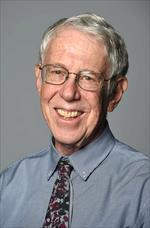
This is a lovely picture of Howard from his UCSF profile page.
Howard Fields died at the beginning of this month. I spent more than five years in his lab (1987-92). He excelled at science and friendship. I already miss him.
Howard was clearly the leading thinker in the study of pain modulation. It was a heady time for the field. Great scientists abounded: John Liebeskind, Bill Willis, Jean-Marie Besson, Tony Yaksh along with Barry Sessle, Ron Dubner, and Ed Perl on the primarily pain side of things. Howard pushed the field with his ideas and bold predictions.
Howard was tall, thin, and red-headed. His face was lively, his eyes sparkling. He found something of interest or amusement, or oftentimes both, in big and little moments alike. To convey a new or funny thought, he would set the scene. Then he would arch one brow, his face still for a pause of perfect comedic timing. After a beat, his face came to life again in a smile as he delivered his nugget. This was a big chunk of Howard’s magnetism. I always felt good after talking to him. I think that many, many people share that sentiment.
Howard was a physiologist
In addition to being the leading thinker in the field, Howard was a bona fide physiologist. He started out studying circuits in crayfish as a doctoral student with Donald Kennedy at Stanford. It is worthwhile to see how great a physiologist he was.
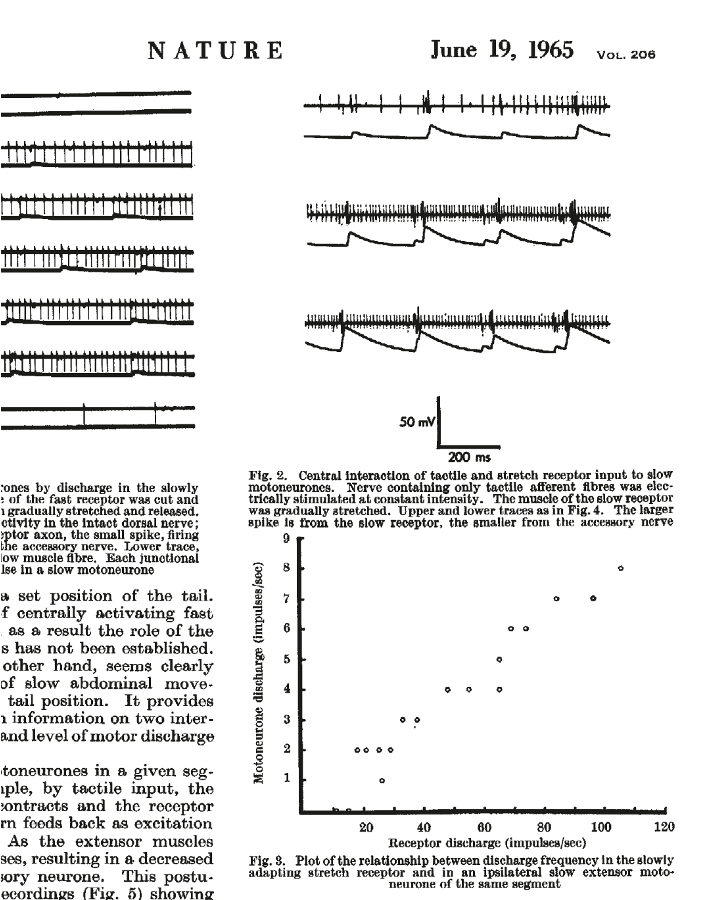
Recordings (top) and summary data (bottom) from Fields and Kennedy 1965 in Nature show Howard’s talent was evident from the start.
Look at the clean recordings. Beautiful!! Then look at the summary graph. No stats necessary. Anyone can see that the discharge of these two cells is related, and linearly so. This is the mark of golden hands owned by a person who picks problems and addresses them with such clear-minded thoughtfulness that the data simply flow. A great way to start a career.
Howard puts down a marker: a hypothesis of the physiological mechanism of morphine analgesia
In the early ’80s, Howard had put down a marker with a bold hypothesis that invented a scientific field of inquiry. He challenged others to prove or disprove his proposed mechanism for morphine analgesia. Not everyone loved the model but everyone had to take note of it. Any naysayers had to incorporate the substantial evidence that Howard accumulated in his lab. Howard had widespread correspondence and filed away all that he collected in a filing system that was a beauty to behold [this was the era or physical “reprints” – no digital copies].
To come up with his idea, Howard had fearlessly plunged into recording from neurons in the medial medulla. Physiological recordings from the brainstem of an anesthetized rat are a world apart from recording from a crayfish ganglion. Again, Howard obviously had the hands to back up his bold venture.
Together with Allan Basbaum, Howard had showed that the medullary raphe (from the Greek word for seam, raphe refers to nuclei that sit on the midline) is the upstream bottleneck in the descending analgesia pathway, the brain circuit that morphine hijacks to produce pain relief. In his physiological experiments, Howard found that one group of cells – which he named OFF cells – shut off just before a rat flicked its tail away from the heat of a light bulb. Then Howard found that morphine caused OFF cells to fire continuously. The OFF cells did not shut off in the presence of morphine. The rat did not flick his tail away from the heat.
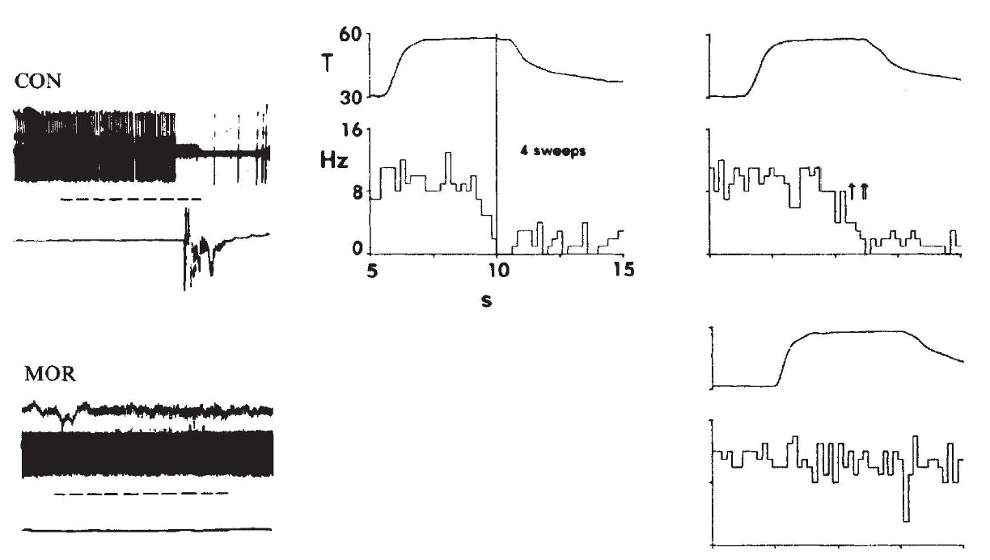
The critical figure from Fields, Vanegas, Hentall, and Zorman (1983), published in Nature, showed the clear association between morphine’s blocking the tail flick (vertical line in the top middle graph) and the OFF cell pause (left column shows raw recordings, right column shows summary histograms). Both effects were reversed in parallel by naloxone (in the original figure but not reproduced here).
Howard was off to the races. Being well read in basic neurobiology, he made an analogy between OFF cells and omnipause neurons. The latter were already well described in the early ’80s when Howard was doing these experiments. Omnipause neurons stop firing just before a saccade (a ballistic movement of the eyes, typically intentional). If the omnipause neuron does not pause, the saccade does not happen. If the OFF cell pauses its discharge in response to heat, the rat flicks his tail away from heat. On the other hand, when morphine is on board, no OFF cell pause and no tail flick.
I head to Howard’s lab
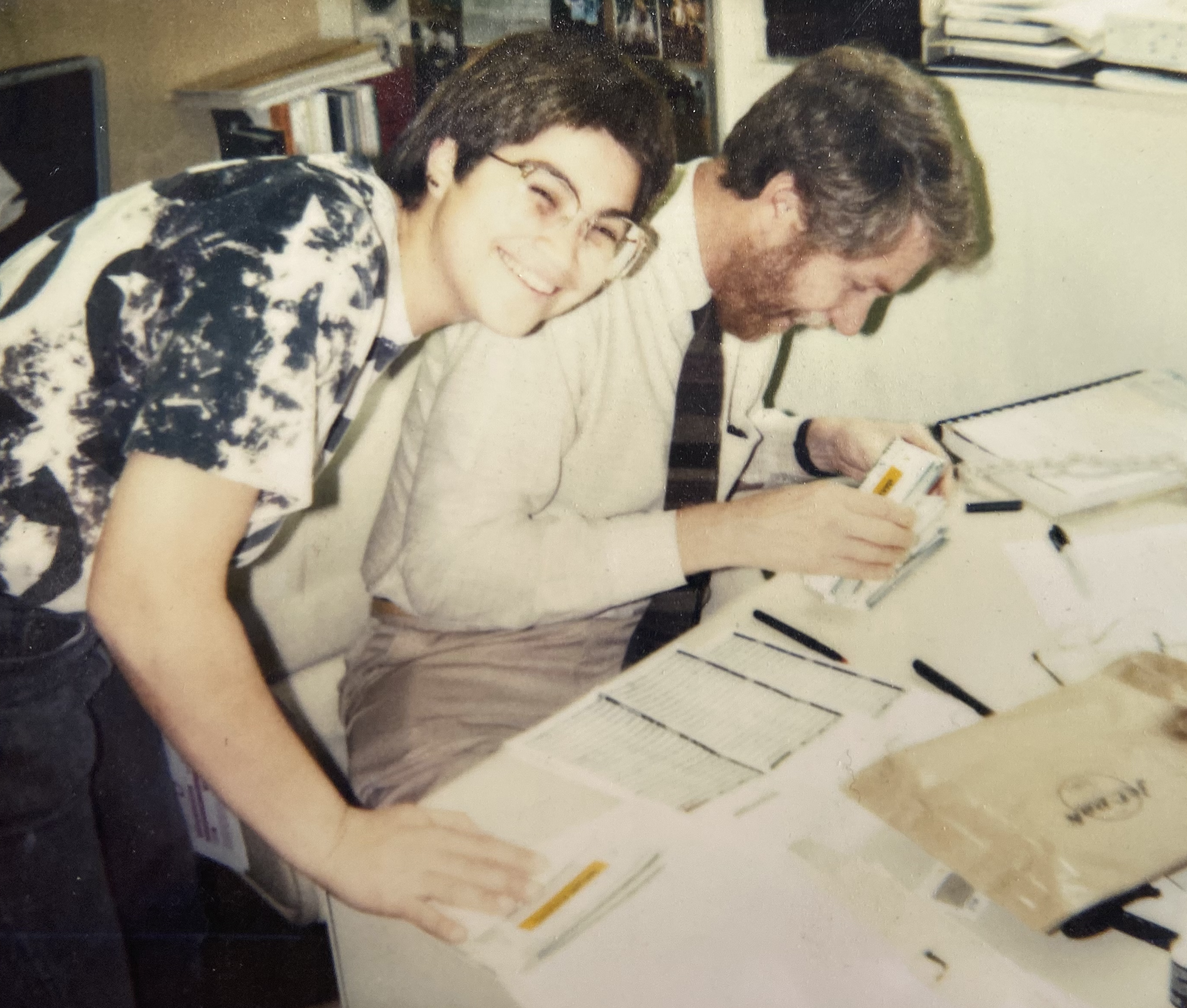
Here I am bugging Howard as he is working away. I have no idea who took this photograph, circa 1988.
By the time I started to think about where I wanted to go for post-doctoral training, Howard had put down his marker and backed up with a series of inspired studies. His lab was the place to be for anyone interested in pain modulation. It certainly was the [only] place that attracted me.
What’s more, I knew that I liked “talking” with neurons, the essence of single cell electrophysiology at the time. As an undergraduate in John Dowling’s lab, I recorded from neurons in the retina. In my graduate work, I recorded from neurons in the medullary raphe, the same region as Howard. A neuron chattered along. I did stuff. In John’s lab, I flashed lights. As a graduate student, I stimulated brain regions that sent projections to the raphe. The neuron responded or didn’t. I continued the conversation for as long as I could “hold” the cell. Eventually, I accumulated enough recordings to figure out how to translate what cells were “saying.” The most fun type of puzzle: difficult but solvable.
As fate would have it, my graduate advisor had trained in gaze control and although our focus was pain modulation, gaze control remained in the air. I was able to fully appreciate Howard’s grounding his model in the omnipause neuron. Truly, Howard’s lab was the place to go for postdoctoral training.
Howard was the best hypothesis-maker I have ever known. Howard worked a problem until he could fashion a testable hypothesis. Then he set up experiments to test his hypotheses. I was (and remain) naturally more suited to science of the observe-and-see-what-is-interesting variety. I knew that I needed to learn about hypothesis-driven science.
My quest to get to Howard’s lab after I graduated was aided by my training. Luckily, I possessed a skill that Howard wanted. Stick and stain refers to sticking an electrode into a neuron, recording its activity, and then injecting a dye to label it. I did this “for a living” all through graduate school. I loved everything about the method. I loved my “conversations” with a neurons. I felt wonder when I found that same neuron in all its anatomical beauty in one of more than a hundred slices through the brain.
Hoping that he would accept me into his lab, I met Howard at one of the inaugural Society for Neuroscience Neurobiology of Disease Workshops. The topic was pain, specifically pain modulation. The place was Anaheim.
A personal diversion: I detour to some personal background here. I had come out just before entering graduate school in 1983. AIDS was just emerging at that time. Back then, the Obergefell v Hodges decision of 2015 would have been considered as hallucinatory as Beam-me-up Star Trekian transportation. That is to say that far from the SCOTUS sanctioning lesbians and gay men to marry, American courts and public felt fine about openly targeting homosexuals for ridicule, discrimination and violence. I was in the closet at school while living an open life outside. I didn’t like being in the closet. I made the decision to be out when I moved on to my next position.
This is all to set the stage for the conversation that Howard and I had, sitting on a stone wall outside the Anaheim conference center. I told Howard I wanted to go to his laboratory for my post-doctoral training. He told me that he wanted me to come to his lab. We were just about set.
“I need to tell you something.”
“Okay.”
“I’m a lesbian and if that is not okay with you, I can’t come to your laboratory.”
Howard just looked at me. His face showed confusion. He shrugged.
Today I cringe at my younger self’s aggressive defensiveness. True to the complete non-issue that Howard viewed my being a lesbian as, he did not remember this incident when I brought it up years later. It simply made no difference to him, then or ever.
Howard ran a fun, productive lab
I worked with Howard from June 1987 through August 1992. Howard was a thoroughly involved but accommodating boss. He pushed. He also listened and accommodated his goals to the interests of the person in front of him. As much as he tried, most of what I produced in his laboratory was more discovery science than hypothesis-driven. The thread of a hypothesis was that ON (the yin group of neurons to OFF cells’ yang) and OFF cells would have different anatomies. [A terrible hypothesis if there ever was one.] Well, the answer to that was a resounding No. Nonetheless, I was able to concretize Howard’s ON and OFF cells.
Howard and I both enjoyed gambling. We drove off to Reno a couple of times for a few hours of blackjack. Probably, we lost whatever money we came with or maybe broke even, I have no recall. Didn’t matter. Fun conversations, fun times.
Howard was generous. His laboratory had space for four independent experiments. When I was there, two other postdoctoral fellows and I occupied three of these rooms. Howard “gave” the fourth to a neurology resident doing interesting work that had nothing to do with Howard. He had done this before and I expect he did it again after I left. Few PIs (Principle Investigator, aka the head of a lab) did or do this. Generous.
1987-92 were the heyday of the Oakland As. The Bash Brothers, Jose Canseco and Mark McGwire, hit home runs at a ridiculous pace. I remember being at one of many playoff games from those years and watching Jose just flick his wrist to send the ball out of the park, possibly out of the stadium. A similar flick of my wrist would have sent the ball blooping about 3 feet away. That is, if I had connected at all. There was more to the As than the Bash Brothers. Rickey Henderson stole bases, Walt Weiss made double plays, Dennis Eckersley closed out games.
Several of us in the lab liked baseball and reveled in the As. We purchased season tickets together. This happened probably two or three years in the six years I was there. One day, Howard, his wife Carol, Gisèle (my girlfriend then and my wife since 2006 once same-sex marriage became legal in select jurisdictions), and I were at a game together. A foul ball came flying toward us and landed squarely in Carol’s lap. She hadn’t moved an iota (and never would have).
Even as we were all shouting our surprise, a boy came bounding across seats and people. He was breathless with excitement.
“Can I have it? Can I have it?”
Carol met his breathless excitement with calm serenity.
“Yes.”
She handed the ball to the boy.
Carol practices Buddhism.
This story is about Carol for sure. But it also tells you something about Howard. That is the woman that Howard married, had two children with, and spent his life with. Good choice.
Howard’s parting advice: Think! Say something! Seek criticism!
To return to what sets Howard apart, he was always the person saying something.
In 1992, I left Howard’s lab to start my own at The University of Chicago. Howard gave me parting advice, from which I only remember one item. He recommended that each week, I spend one hour in the dark… thinking. This is so Howard. For all his energy, sociality, and liveliness, he was never frantic. He valued deep thought, viewing data, and ideas from multiple angles, going down rabbit holes of thought. I have not followed Howard’s advice to the letter but I also have never forgotten it.
Much later, Howard would review manuscript submissions for me (for periods of time, I was a reviewing editor at Journal of Neurophysiology and eLife). He typically said yes to the manuscripts I asked him to review. However, every once in a while, he would decline. Once I asked him why he had declined to review a particular paper for which I thought he was well suited. He told me that the authors weren’t saying anything, He wanted a paper to declare something. A title should be a declaration, not the description of a category. Howard was not interested in scientific investigation per se. He wanted scientists to do real scientific work, to say something even if that meant going out on a limb and even if that something proved wrong eventually. Howard’s two scientific heros (Pat Wall of Melzack and Wall 1965, Science; and Norm Geschwind, a legendary neurologist) were of this ilk.
In one of our last conversations, I was complaining about the pablum nature of scientific debate these days compared to the metaphorical knock-down, drag-out fights of old.
Howard said to me, “As Lao Tzu said, ‘He who compliments is a thief; your critic is your best friend.'”
Touché, my friend.
I have just skimmed the pain modulatory surface of Howard’s life here. For a full obituary, please see the excellent piece by Natalie Mesa in The Transmitter.
Categories: Gaze control, History, obituary, Science


Thank you for sending this! I read the piece in the transmitter yesterday – they did a great job. Looking forward to reading this.
What an awesome pic of you and Howard! Love it! Hereâs the only pic I have – from Big Sky – winter brain.
[IMG_4498.jpeg]
LikeLike
“He excelled at science and friendship”. What a spectacular eulogy. My deepest condolences for the loss of such a dear friend.
LikeLike
I wish you comfort and peace on the loss of your dear friend and colleague. 44 years of chronic pain gives me an intense appreciation for his research.
LikeLike
So sorry for your loss, Sweet Friend – Howard sounds like an amazing mentor and friend. Sending lots of love and hugs your way.
LikeLike