
Aims of Education
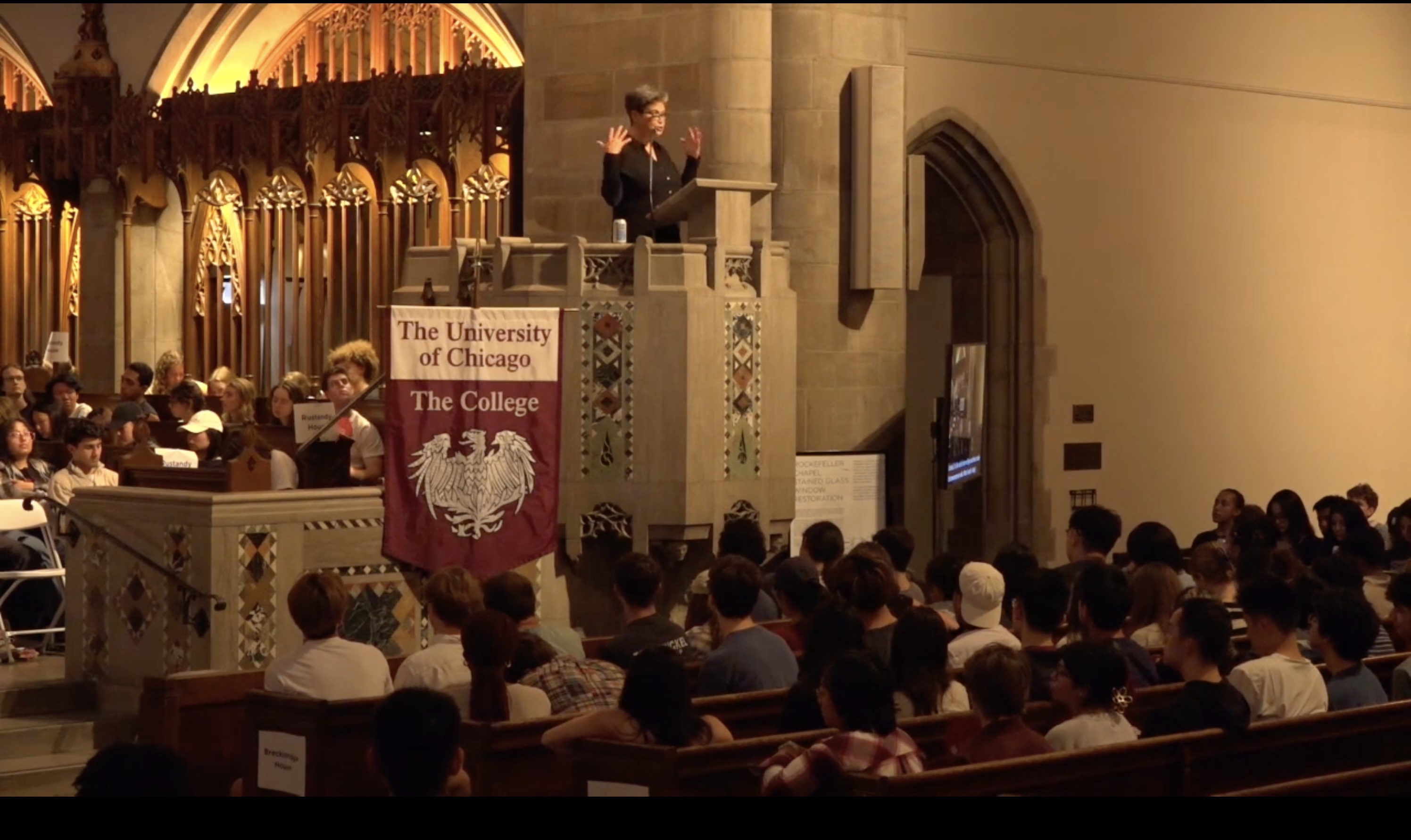
This year I was honored that the University of Chicago Dean of the College Melina Hale asked me to give the annual Aims of Education address to the incoming students. I immediately accepted and the following is the speech that I wrote out for the occasion. It nearly matches the speech that I gave which is available online. [Note that this link (changed on October 9, 2025) takes you to the YouTube version that starts with Dean Hale’s introduction. My remarks start at 5:25.]
As I wrote this, I thought not only about UChicago undergraduates but also about the students at the University of Chicago’s Graham School who I have had the pleasure of teaching and befriending over the last several years. “Graham-ers” vividly demonstrate that the learning journey is life long, really not just as cliché.
Therefore, in the spirit of talking to all of you readers, life-long learners who are not in the UChicago College and may not yet be in Uchicago’s Graham School [It is never too late.], I post my thoughts on the real aims of teaching and learning, that thing we call education.
Aims of Education 2025
Thank-yous
Thank you to Dean Melina Hale for this opportunity to talk to you, the class of ’29 and to transfer students joining the classes of ‘27 and ‘28. Welcome to the University of Chicago College. I also thank my colleagues and everyone joining us online for this chance to share my ideas.
I do not take lightly your decision to spend with us a sizable chunk of your most valuable resource, the one life you have. I further recognize the magnitude of your entrusting us to be the ones to foster a journey of intellectual growth, change, and curiosity that you can enjoy over a lifetime.
You are all good to go on explicit learning – not my focus
You all excel at the type of knowledge-acquisition that leads to degrees and professional employment and in-fact admission to the University of Chicago. We can provide this type of instruction for you – of course – but, realistically, so can many other colleges. Truth be told, you could google-video your way to that type of learning in many subjects.
Knowledge-acquisition is explicit learning. It is a type of learning that you are fully aware is going on. Memorizing a poem to recite in class, learning vocabulary in a new language or how to calculate a differential equation, articulating the philosophy of Audre Lorde. These are all examples of explicit learning, learning that is intertwined with language. I suspect that this is what many envisage the college years are all about.
And it is true that your college experience will involve learning knowledge and methods of inquiry and developing skills at articulating what you have learned. But alongside mastering the ideal gas law, neuroanatomy, and the role of Manet in launching modern art[1], I hope for something very different for you.
I want you to learn to be uncomfortable, to take intellectual risks, grow as a thinker, accept and ultimately revel in the severe discomfort that accompanies exposure to and potential adoption of a perspective that clashes brutally with long-held beliefs. Persevere on a thought path even if distress storms in.
Implicit learning
Learning to carry on through discomfort is not achieved consciously. It is an example of implicit rather than explicit learning. Because it lacks a direct connection to language, implicit learning is ineffable – impossible to perfectly articulate, describe, or explain. It is explicit learning’s counterpart.
You can assign Wednesday night to buckle down and learn the structure of the Periodic Table (explicit learning). That will work. However, scheduling Thursday night at the Reg to learn to tolerate intellectual discomfort (implicit learning). That won’t work.
So how do we learn a habit of mind such as developing comfort with discomfort? To understand how, let’s look at the superstar of the implicit learning family – and that is motor learning.
Toilet training
To illustrate how implicit motor learning differs from explicit learning, we will compare two approaches to teaching children to control their bladders – what is called toilet training in the U.S. In one approach, babies learn to control urination by six months of age, at a time when they neither speak nor understand language. In a second approach, widespread in Western culture, toilet training involves conversations between parents and their toddlers. As we will return to, parents are under the impression that it is these discussions that lead to the child’s being toilet trained.
Just a touch of background. All mammalian babies, human or otherwise, store urine and empty their bladder just fine. In fact, they start doing so in utero. No surprise then that the task is not learned but rather is accomplished entirely by reflex. This tells us that toilet training is not about teaching children to void per se. Rather, it is the process of transforming urination from an automatic reflex to a volitionally initiated one.
We’ll start with toilet training in today’s North American and European cultures. The process that starts when a child is anywhere from 1½ to 3 years old. The Mayo Clinic advises the following:[2]
“Start teaching your child simple words like ‘pee’ … and ‘potty.’ Say these words often. You can tell your child that every person pees. You also can explain that pee [is like] garbage that the body makes. But don’t use words such as dirty or yucky.”
The Mayo Clinic continues by advising that upon seeing signs that a toddler “needs to go to the bathroom,” the parent says, “it’s time to pee.” At 21 months, the parent is advised to explain toilets so that the child “knows that the toilet and potty chair are used for passing urine.” There is far more but I will not belabor the point.
Once the child is deemed ready, Mayo advises putting the child on the toilet whenever the child “shows signs of needing to pass urine” – think of a toddler’s squirm-dance – or in any case, every two hours or so.
Now let’s talk about the other approach where babies are “dry,” meaning in control of their bladders, by six months of age. Such early toilet training is the custom in much of Asia and Africa today and in fact, was the rule in the U.S. as recently as the late 1930s.[3, 4]
How is early toilet training achieved? Essentially the same way that Western toilet training finally comes about – through practice. Early toilet training simply cuts out the preamble of conversing about pee and potties and cuts to the chase. As an example, almost immediately after a baby’s birth, a mother of the Digo tribe of Kenya starts training her baby.[5] Upon seeing signs her baby needs to urinate, the Digo mother places the baby between her thighs and makes a shuuuush sound. When the baby urinates – which he almost invariably does – the mother cleans, feeds, and cuddles the baby. The mom repeats this process day in and day out, thereby conditioning her baby to initiate urination only when in place.
With nary a word – no potty, no pee, and certainly no blah blah blah about the body’s garbage or how toilets work, the baby is “toilet trained” meaning that the baby controls when he initiates urinating. All this happens before the baby utters a single word or takes one halting step.
Is it really true that Western children, the recipients of much teaching, are learning from that explicit verbal instruction? This is highly unlikely. For starters, we do not have any more control over contraction of the bladder – a smooth, involuntary muscle – than we do over sweat glands or our left ventricle. That is to say, no voluntary control whatsoever.
Now think about it. The conditioning – anticipating when the child needs to urinate and putting the child in place to do so – ends up being the same in early and late toilet training. The big difference is that in early toilet training, conditioning takes place when the child is pre-verbal whereas with late, Western, toilet training, the child has begun to learn language. In sum, the narrative of a child being toilet trained through conversation is a case of pasting a veneer of verbal instruction on top of implicit motor learning.
Implicit motor learning
Initiating urination is neither the first nor the only thing babies acquire using implicit motor learning. Instead, it is the rule for how we figure out how to make the movements we make.
When I watch a baby, I imagine an internal dialogue along the lines of: Oh look, my leg is moving. Wowwy, my hand is opening and closing, opening and closing. Hmmm, this makes my arms move. Movement follows internal thought by an imperceptible moment in time. Again and again.
Different thoughts produce different movements. Through repetition, babies learn to associate the internal brain experience that produces a movement with the specific movement that was produced by that internal experience: thought A1 flexes my left thumb, thought A2 flexes my left pointing finger and so on. In this way, babies wire up their motor system.[6] They learn which brain-button to press for which movement.
Learning and making movements implicitly is the rule. Consider a completely intentional action: steering a car through a lane change. As David Eagleman explains in Incognito, when asked to describe how to move one lane to the right, people say they would “bank the steering wheel to the right for a moment and then straighten it out.” [10 min] This would in fact “steer you off the road” and eventually in circles. Eagleman provides the correct answer: “bank to the right, then return past center to bank just as far to the left, only then do you straighten out.” Beyond being a plug for Newtonian mechanics, this example shows us how even a completely volitional, completely conscious act – I want to change lanes – gets accomplished using subconscious motor pathways that are not verbally accessible.
The lesson is clear: we can and do learn implicitly.
We implicitly learn the hookup of brain to muscles
To learn the hook-ups between brain and muscles, a baby “babbles” with her legs, arms, and eyes. She is experimenting. Trying stuff, observing the consequences, associating the push of a brain-button with a motor effect. Ultimately the brain acts as an orchestral conductor who directs muscle “instruments” to produce coordinated movement “music.” But before it can perform this function, the baby brain needs to learn how its own brain buttons hook up to muscles.[7]
This learning step – all implicit of course – is the reason that you have never seen a coordinated baby. The brain does not know how to call on the right instruments at the right moments “out of the box.” It must learn this. And it makes no assumptions, does not assume two arms, two hands, two legs and so on. A baby exposed to thalidomide in utero may not have the typical complements of limbs and digits. The configuration of limbs for conjoined twins varies widely. The size and strength of the muscles in your two-, twenty-, and sixty-year-old selves differ substantially. Heck, the strength available in your muscles changes from morning to night. How you walk changes as you move from hard packed earth into a quagmire of mud.
The brain metaphorically eats up all the errors produced by changing conditions as though they were manna from heaven. It uses them to modify its conductor routine to match the needs of the ever-changing body in its ever-changing environment. The brain coordinates movements regardless of the number, length, or weight of limbs. The brain simply waits for you to make errors so that it can correct them, finally bringing your actual movement in line with that smooth graceful movement you intended to make. But it can only do this if it gets enough mistakes to work with. No errors means no learning. Playing it safe is simply not going to work.
No first-try-success
There is a lesson in this bit of neurobiology. One that in fact, you already know … implicitly. Dance the jitterbug, play the saxophone, pull off a yoga pose, type on a French keyboard, unlock your dorm room. Does anyone perform these actions perfectly the first time? Absolutely not. No more than a baby can skip toddling to take her first steps at a gallop or bypass ma-ma to say supercalifragilisticexpialidocious as her first word.
The brain cannot work on nothing. A person must toss their hat in the ring, give it a go, even with the full knowledge that there is no way to succeed on that first try. Getting to competence for any action takes errors. Errors accompany the stumbling and bumbling of trying. That is inevitable.
Segue from motor to intellectual
Just as walking, piano-playing, and the pronunciation of foreign words don’t happen on the first go, neither does intellectual risk-taking.
Getting to be comfortable with discomfort, discordant and incongruent thoughts – this just does not happen without trying and failing. Repeatedly.
Nico example
Nico, a Class of 2024 UChicago graduate, felt that he had become “complacent in [his] lack of development in the humanities.”[8] In reaction, he deliberately enrolled in an elective far outside his science major. He had “hopes of finding another voice—another side of myself.” All very UChicago.
It worked.
“I had to be vulnerable, making many mistakes at the beginning … half-baked ideas and quick responses… I had to learn how to articulate my ideas in a more effective manner, and so I tried, and tried.”
Trying paid off.
“Where before I had barely found time to do the readings, now I was searching for more time in the library, going down rabbit holes with favorite works.”
The rewards for seeking intellectual challenges are the riches of a full and varied intellectual landscape without fences, without No trespassing zones.
Learning is not one and done
Motor learning lasts a long time – you only need to learn to ride a bike once. But motor performance requires practice and updating as you become stronger or weaker, more or less agile, and so on. Ideas often need updating too. Sometimes tweaks, sometimes overhauls.
In The Structure of Scientific Revolutions, Thomas Kuhn discusses paradigm shifts when new interpretations emerge that approximate truth better than the old interpretations did. Kuhn wrote that “novelty emerges only with difficulty, manifested by resistance, against a background provided by expectation.”[9] In other words, established thoughts serve to resist changes, even changes that bring us to a better understanding of the world.
Overcoming expectations, your own, that of your parents or friends, is your problem to face down. Why? Because you owe it to yourselves. Let’s use a motor analogy again. I want you to imagine whatever sport or video game you enjoy playing. Do you play as you always have and resist trying out a new idea?
Imagine: My forehand is good. I will stick with that; I don’t need to bother learning a backhand.
There’s no way. Instead, off you go to learn the backhand, whiffing at first perhaps but ultimately improving and eventually achieving some competency. Same approach with intellectual skills.
Do not tolerate No Fly Zones in your thoughts. Even when they are painfully uncomfortable.
I know this is difficult. I will give you a personal example that unhinged me for a spell. I got interested in the history of Down syndrome. This led me to Jerome Lejeune’s discovery that Down syndrome is associated with three copies of chromosome 21. I started to read about Lejeune himself, who like Langdon Down – for whom Down syndrome is named – and others who worked with Down children, sang the praises of these children. Lejeune devoted much energy to campaign against the termination of Down syndrome pregnancies.
As I was reading a biography of Lejeune, I read a sentence, the upshot of which was that “the only difference between a 6-month fetus and a baby born at the same age is their ‘last known address.’” I reeled. Immediately I saw the implication that if killing one is acceptable than so is killing the other, that either abortion and infanticide are both okay or that neither is okay. Instantly enraged as this idea clashed with principles I was raised with and had never questioned, I e-slammed the article shut and dumped it in the trash. I seethed. I lost sleep. Still, I could not stop thinking about this “location” idea.
As much as I did not welcome this novel perspective on abortion and infanticide, I could not but acknowledge the logic. Not admitting this would have been dishonest. But it was not just that.
Coming to accept the reasonableness of the thesis that had initially so outraged me was not an adoption of Lejeune’s perspective. I did not trade in one certainty for another. Rather, I traded in certainty for a more challenging and more interesting terrain filled with examination, questions, and skepticism. Not only did this texturize my own intellectual landscape, it also allowed me to admit additional ways of viewing the topic and discussing it with others. Sitting in a bubble of opinion serves no one, least of all yourself.
The dangers of walling ourselves off from ideas was beautifully articulated by the great English philosopher John Stuart Mill, “The peculiar evil of silencing the expression of an opinion is, that it is robbing the human race; posterity as well as the existing generation; those who dissent from the opinion, still more than those who hold it. If the opinion is right, … [we] are deprived of the opportunity of exchanging error for truth: if wrong, …[we] lose, what is almost as great a benefit, the clearer perception and livelier impression of truth, produced by its collision with error.”
What Mill is saying is something that happens all the time in laboratories where procedures can be long, involving many steps. Not every step has been independently tested which makes the entire sequence part science and part custom.
A newbie comes in “Why do you do A and then B? Can’t you just skip to B and cut out A altogether?”
One answer is “Actually, we need to do A just in case such and such happens which would preclude step B.”
The other answer is, “Hmm, that is a great point. I wonder if that would work. Let’s give it a shot.”
The question invariably produces a win. Either the newbie learns something or the laboratory veterans realize that they have been looking at the problem through such habituated eyes that they have become blinded to what is in front of them.
Attack all ideas with skepticism. Question the evidence, consider the interpretation. Be intellectually playful. Even when answers appear patently obvious.
In In Memory of W.B. Yeats, W.H. Auden wrote,
“He disappeared in the dead of winter:
The brooks were frozen, the airports almost deserted,
And snow disfigured the public statues;
The mercury sank in the mouth of the dying day.
Oh all the instruments agree
The day of his death was a dark cold day.”
In this Auden verse, I see a guiding principle of a rich intellectual life. In order to discern something as simple as the timbre of a day, approach with skepticism by seeking confirmation from all available sources and perspectives. One instrument is not enough. Nor is two. Use a thermometer, airport’s emptiness, the time of year, presence of snow to test if the day of Yeats’ death was indeed dark and cold. Use all of your intellectual instruments to evaluate the evidence and arguments to come to your reasoned conclusion.
This leads me to my final point which is Enjoy the ride. Here is how Class of 2025 graduate Amelia[10] put it:
“while the easy, sudden, lightbulb imagery might be prevalent in pop culture, the reality of [intellectual] shifts is that they [are] as uncomfortable as they are rewarding. I learned to sink into the nuance, to sink into the grey area, to ask questions for the purpose of exploration rather than clarity.”
To pick up on Amelia’s point, the pleasure of being right and gaining clarity is fleeting. I was right. Yay, two plus two is four. Yahoo. Case closed. Pleasure’s short duration is not terribly surprising as evolution favors craving and striving over stagnating, couch-potato-making happiness.
Watch winners and losers of championships. The champions are ecstatic… for a moment. The smiles and happy tears pass quickly. The runners-up, on the other hand, burn with a fire evident on their faces and in their demeanors that can last for weeks, months, and years to come. This fire fuels redoubled efforts to gain a championship in the next contest, the next season. As neuroscientist Kent Berridge writes, “Wanting or craving … [depends] on a large and distributed brain system [whereas] pleasure itself is generated by [just a few small] spots” in the brain.”[11] Metaphorically, you get to wanting almost every time you turn a corner in the brain but pleasure hotspots are down hard-to-find alleyways. Even when a hotspot is reached, happiness is only briefly felt. Enormous evolutionary advantages accrue from wanting and craving. Not so much from existing in a satisfied state of bliss.
Be wrong, be unsure, and celebrate those feelings. Learn to not just avoid discomfort but to run to it.
No one toilet trains in a day. Intellectual expansiveness is not the product of one course, one year, one college degree, and not even one lifetime. During the next four years, use the faculty, the bountiful resources of UChicago, your fellow students,[12] and most importantly your precious time to condition yourself to being flustered, exhilarated, agitated, exultant, upset, and triumphant as you embark on your own most uncomfortable and simultaneously most rewarding life of intellectual quest. To paraphrase Joseph Campbell, reach for a “bolder, cleaner, more spacious and full[er intellectual]… life.”[13]
Grow as a thinker, take risks, change your opinion even when that change brings you severe discomfort. Learning the habits of thought that will fuel a life-long affair with thinking and exploring, doubting and growing, changing and modifying your views is worthy of four years of your time.
The end
[1] h/t Christine Mehring
[2] https://www.mayoclinic.org/healthy-lifestyle/infant-and-toddler-health/in-depth/potty-training/art-20045230
[3] Wu HY. Achieving urinary continence in children. Nat Rev Urol. 2010 Jul;7(7):371-7. doi: 10.1038/nrurol.2010.78.
[4] deVries MW, deVries MR. Cultural relativity of toilet training readiness: a perspective from East Africa. Pediatrics. 1977 Aug;60(2):170-7. PMID: 887331.
[5] deVries MW, deVries MR. Cultural relativity of toilet training readiness: a perspective from East Africa. Pediatrics. 1977 Aug;60(2):170-7. PMID: 887331.
[6] Ian Waterman lost his sense of touch and body position from the neck down at the age of 19. In order to move, he had to “forge a link between mind and muscle” as an adult, exactly what babies spend the first years of their lives doing (without language). See The Man Who Lost His Body (BBC Documentary, Horizon series, 1997).
[7] Here, I imagine an old-fashioned switchboard operator learning how to connect incoming calls to the right offices. In fact, I imagine Rosalind Russell in Auntie Mame. Her character Mame Dennis takes a job as a switchboard operator and plugs incoming calls into offices that are invariably incorrect. If you have not seen this movie, go directly to find it and watch it.
[8] Nico Zerda
[9] h/t Amelia Cheng
[10] Amelia Cheng
[11] Berridge KC, Kringelbach ML. Pleasure systems in the brain. Neuron. 2015 May 6;86(3):646-64. doi: 10.1016/j.neuron.2015.02.018.
[12] h/t Gautham Reddy
[13] The Hero with a Thousand Faces (1949)
Categories: Education, Psychology, Uncategorized


 The brain is sooooo cool!
As usual, you taught me something new – Love you more than you know!
LikeLike
thank you for sharing these beautiful reflections!
LikeLike
Congrats. As usual you hit it out of the ballpark.
LikeLike
Dear Peggy I really enjoyed reading your article, as usual. Things have changed even with “toilet training” – the introduction of disposable diapers in most Western countries caused a further postponement of this . My children were born 1975/76/79 diapers had to be washed so parents started much earlier ……in Israel there were disposable diapers available , but in the beginning they were imported and mega expensive and therefore only for “special occasions!!” I really enjoy reading articles about the brain science ( how it works and why it usually works that way ) I used to work as an X-ray tech and learnt more of the anatomy of the brain doing CTs etc I wish you and your partner a future filled with much health and happiness , success, love and PEACE Sincerest thanks
Suzie 🪻💜🌷💝💖💝🌷💜🪻
LikeLike
Dear Sue,
My mom, born in 1928, was toilet trained by 6 months old, supporting the contention by the deVrieses that early tt was the rule through the thirties. When I learned this, I immediately questioned why customs changed. And of course, my first thought was the diaper industry. BUT I am not sure that is right. I am not sure that the timing is correct and your comment suggests it is not. Dr Spock and other influences might have been pieces of it. In any case, I would love someone to look into this and figure out the likeliest sequence of events
Best
Peggy
LikeLike