Author Archives

Peggy Mason
Peggy Mason grew up in the Washington DC area and worked in taxidermy at the Smithsonian Museum of Natural History during middle and high school. She received her BA in Biology in 1983 and her PhD in Neuroscience in 1987, both from Harvard. After postdoctoral work at the University of California - San Francisco, she joined the faculty at the University of Chicago in 1992. Dr Mason is now Professor of Neurobiology. For more than 20 years, Dr Mason's research was focused on the cellular mechanisms of pain modulation. In the last ten plus years, Dr Mason has turned her energies to the biology of empathy and helping behavior in rats.
Dr Mason taught medical students for 25 years and wrote a textbook for medical students, now in its second edition (Medical Neurobiology, Oxford University Press, 2nd edition, 2017). Dr Mason started the Neuroscience major at UChicago and was awarded the Quantrell Award, the nation’s oldest prize for undergraduate teaching, in 2018. More broadly, Dr Mason is a neuroevangelist, interested in teaching neurobiology to anyone that will listen. To that end, Dr Mason publishes a blog at https://thebrainissocool.com/ and has offered a massively open online course, Understanding the Brain: The Neurobiology of Everyday Life through Coursera (https://www.coursera.org/course/neurobio) since 2014 with a cumulative enrollment of more than 270,000.

I was out on a small boat going to the Marietta Islands to fulfill a long-time dream of seeing blue-footed boobies (fun to say, don’t you think?) and was trying to take some pictures. Check out how that turned out: The pictures are not steady because my hands moved as the boat rolled, pitched, and rotated on the choppy ocean. […]
Read More →
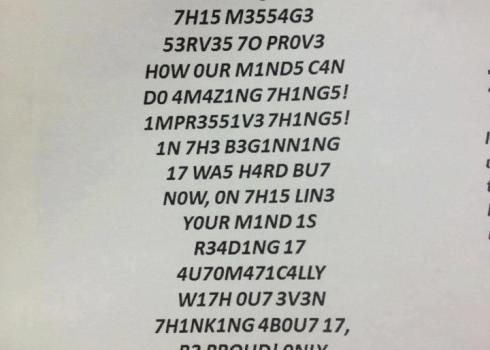
Can you read this? The first lines are the hardest. So if you have trouble, scroll down a bit. Once you have the hang of it, you probably will have no problem reading it from the start. This is a great example of perception as interpretation. We are not cameras and tape recorders. In the case of vision, we use […]
Read More →


 The brain is sooooo cool!